Search
instrumentation
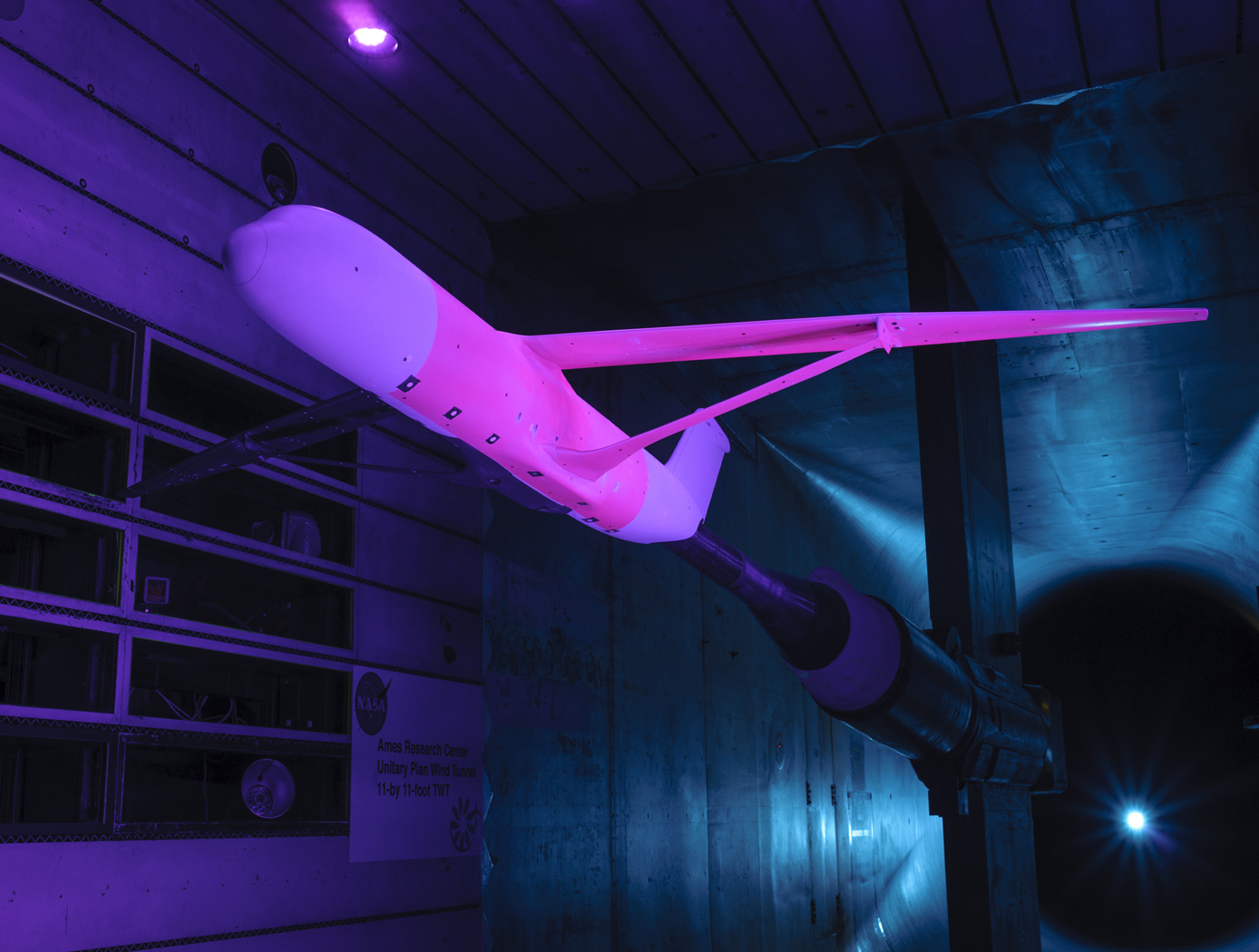
Calculation of Unsteady Aerodynamic Loads Using Fast-Response Pressure-Sensitive Paint (PSP)
Traditionally, unsteady pressure transducers have been the instrumentation of choice for investigating unsteady flow phenomena which can be time-consuming and expensive. The ability to measure and compute these flows has been a long-term challenge for aerospace vehicle designers and manufacturers. Results using only the pressure transducers are prone to inaccuracies, providing overly conservative load predictions in some cases and underestimating load predictions in other areas depending on the flow characteristics. NASA Ames has developed a new state-of-the-art method for measuring fluctuating aerodynamic-induced pressures on wind tunnel models using unsteady Pressure Sensitive Paint (uPSP). The technology couples recent advances in high-speed cameras, high-powered energy sources, and fast response pressure-sensitive paint. The unsteady pressure-sensitive paint (uPSP) technique has emerged as a powerful tool to measure flow, enabling time-resolved measurements of unsteady pressure fluctuations within a dense grid of spatial points on a wind tunnel model. The invention includes details surrounding uPSP processing. This technique enables time-resolved measurements of unsteady pressure fluctuations within a dense grid of spatial points representing the wind tunnel model. Since uPSP is applied by a spray gun, it is continuously distributed. With this approach, if the model geometry can be painted, viewed from a camera, and excited by a lamp source, uPSP data can be collected. Unsteady PSP (uPSP) has the ability to determine more accurate integrated unsteady loads.
Materials and Coatings

Retroreflective Temperature- and Pressure-Sensitive Paints
The retroreflective-enhanced system combines PSP/TSP with specially treated glass microspheres to enable simultaneous surface and flow field measurements. The process involves a multi-layer coating system including primer, epoxy base coat, and acrylic polymer/ceramic binder, with microspheres applied while the binder retains adhesive properties. The glass microspheres may be uncoated, half-coated with aluminum, or pre-processed to be coated in another chemical. The system leverages dual optical characteristics: the underlying PSP/TSP responds to pressure and temperature changes through luminescence intensity variations at specific wavelengths, while embedded microspheres provide retroreflective properties enabling focused SAFS, shadowgraph, or BOS visualization techniques. This configuration allows simultaneous capture of on-body surface measurements and off-body flow field disturbances. The invention enables measurements from a single viewing orientation rather than requiring orthogonal optical access points. While specific excitation lighting, wavelength filtering, and camera positioning are still necessary, the system significantly streamlines experimental setup compared to traditional separate approaches.
While initially developed for aerodynamic testing and flow visualization research, this invention supports optical measurement and surface analysis applications. By enabling simultaneous measurements from a single optical access point, the retroreflective-enhanced PSP/TSP offers a streamlined solution for systems where optical access limitations are critical. The system is a TRL 6, having undergone successful validation in wind tunnel testing, and is available for patent licensing.